

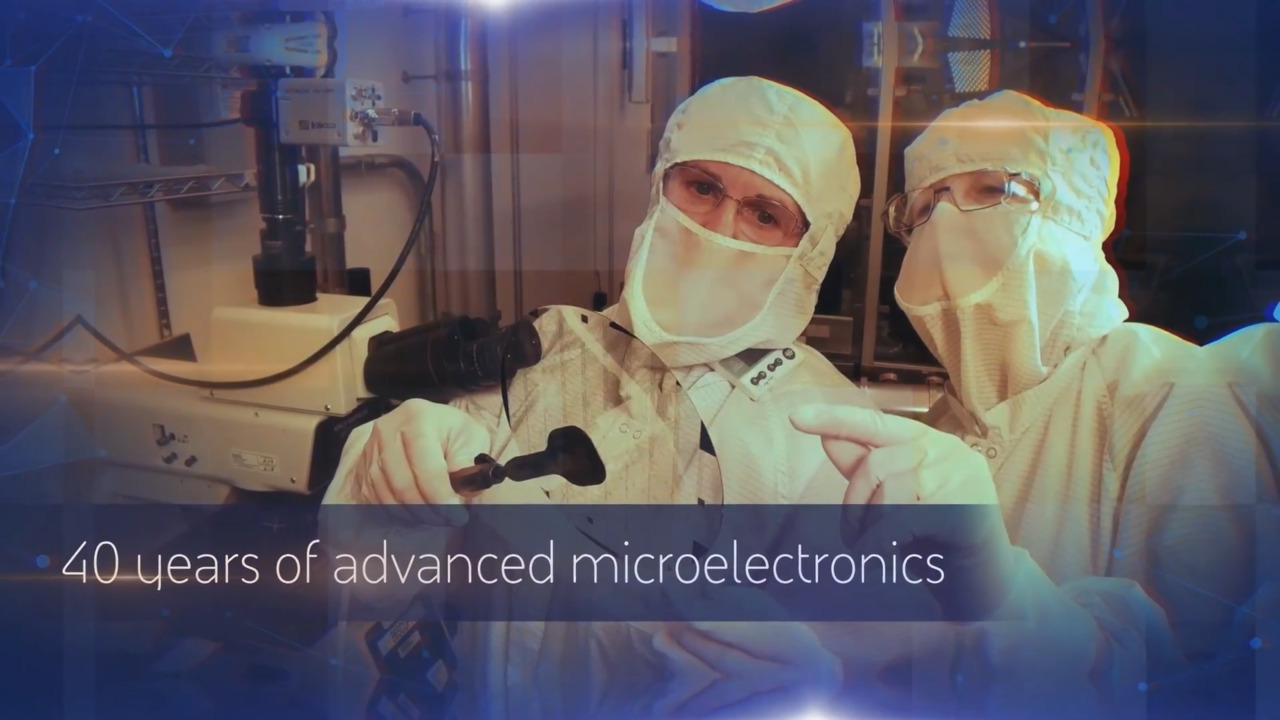
BAE Systems is a global leader in the development of next-generation microelectronics products and services. Microelectronics, the engineering discipline of miniaturizing electronic components and circuits, uses semiconductor materials like silicon, gallium arsenide (GaAs), and gallium nitride (GaN) to develop complex nanoscale microchips, transistors, and sensors. Microelectronics make defense, intelligence and industrial technologies smaller, faster and more efficient.
Overview
Today’s effective use of the electromagnetic spectrum depends on advanced microelectronics to pack adaptive communications, sensor, planning, guidance and engagement technologies into new and legacy platforms of every size and purpose. Across land, sea, air and space, microelectronics serve as the lighter, smarter, more agile brain and nervous system behind modern defense, intelligence and industrial technologies. Without microelectronics, many mission-critical systems would not exist.
The strategic core of modern defense
Advanced microelectronics is not just a technical advantage; it’s a strategic imperative. Smart technological choices at every stage impact system performance, team integration, user accuracy, data security and the outcome of missions. Microelectronics engineers create complex, highly integrated devices that provide processing power, signal conditioning and controls for modern electronics to function in contested or high-threat environments.
The modern battlespace is infused with electronic warfare signals, radar returns, satellite images, communications messages and other data from a wide array of sources. Microelectronics are critical for digesting and interpreting this raw data into smart, actionable intelligence at incredible speeds. Examples include when a Monolithic Microwave Integrated Circuit (MMIC) in a radar system amplifies faint signals bounced off a stealthy target, or when a Mixed-Signal Integrated Circuit (MSIC) in a software-defined radio instantly converts analog radio waves to digital data, filters out jamming attempts and prepares a secure transmission.
Beyond combat performance, the critical need extends to supply chain integrity and national security. A compromised microchip, whether through counterfeiting, malicious tampering or intellectual property (IP) theft, represents a catastrophic vulnerability. That’s why a Trusted U.S. Department of War (DoW) Foundry – a semiconductor fabrication facility accredited by the Defense Microelectronics Activity (DMEA) – is essential. These foundries ensure that the design, manufacturing and packaging of integrated circuits (ICs) for national security systems are protected within a secure, domestic or allied chain of custody, safeguarding against threats that could undermine the very platforms our warfighters rely on. BAE Systems’ FAST Labs semiconductor facility is a Trusted DoW Foundry.
U.S. microelectronics leadership is crucial
The global semiconductor landscape is highly complex and competitive. Commercial markets drive innovation and scale, but defense applications require capabilities that extend beyond commercial offerings, including extreme performance in harsh environments, radiation-hardened (rad-hard) space components and guaranteed long-term availability. These requirements are not guaranteed by the commercial sector.
Assuring a robust domestic microelectronics capability is a matter of national security. The U.S. cannot afford to be reliant on foreign entities – particularly near peer rivals and potential adversaries – for chips that secure communications, process intelligence data or control missile guidance systems. An ample U.S.-based microelectronics ecosystem ensures that the U.S. Navy, U.S. Air Force, U.S. Army, Defense Intelligence Agency (DIA) and other DoW branches have secure, reliable sources for critical components, free from foreign interference or interruptible supply chains. This leadership also fosters innovation, reinforcing expectations that defense microelectronics push the boundaries of what is physically and technologically possible. This can lead to breakthroughs that give the U.S. a technological edge over competitors, while eventually also benefiting broader commercial and industrial interests for decades to come.
Microelectronics enable the modern battlespace
The use of microelectronics is pervasive across every domain of modern defense. They are a vital thread that connects every platform across the fabric of joint operations, including:
- Electronic Warfare (EW) and radar - EW systems are one of the most demanding applications that rely on advanced microelectronics. The systems are designed to instantaneously detect, characterize and jam enemy radar and communications across a wide swath of the frequency spectrum. Active Electronically Scanned Array (AESA) radars, the gold standard in air-to-air and surface-to-air combat, are built upon thousands of individual transmit/receive modules, each containing high-performance microelectronics that generate and receive microwave energy with incredible precision and speed.
- Aerospace and C4ISR - Microelectronics are the core of Command, Control, Communications, Computers, Intelligence, Surveillance, and Reconnaissance (C4ISR) systems on airborne platforms. They process sensor data from Synthetic Aperture Radars (SAR), enable secure, high-bandwidth datalinks between aircraft and ground stations, and manage the flight control systems of unmanned aerial vehicles (UAVs). In orbit, rad-hard microelectronics ensure that GPS satellites can provide precision navigation and timing, and that intelligence satellites can downlink critical imagery, all while operating in the unforgiving radiation environment of space.
- Naval and shipboard systems - On surface ships and submarines, microelectronics manage integrated power systems and drive advanced sonar arrays for undersea warfare. They also power the sophisticated combat management systems that fuse data from dozens of sensors to provide a single, coherent picture of an operational environment.
- Ground systems and munitions - From the advanced targeting systems in main battle tanks to the guidance electronics in precision munitions, microelectronics provide the intelligence and reliability needed for ground dominance. They must withstand extreme shock, vibration and temperature fluctuations. In missile systems, they control the guidance, navigation and fusing, executing complex algorithms in the split seconds before impact.
Key FAST Labs microelectronics products and services
BAE Systems’ FAST Labs stands at the forefront of microelectronics technology, with a deep heritage in designing and fabricating microelectronics for the most challenging defense and aerospace applications for over 40 years. Our expertise spans the entire lifecycle, from custom design to trusted fabrication, allowing us to offer a comprehensive range of advanced microelectronics with a primary focus on high-performance components for demanding aerospace and defense applications.
Key technology areas include:
- MMICs - These specialized ICs operate at RF, microwave and millimeter-wave frequencies (300 MHz to 300 GHz) and are designed for high-performance functions like power amplification, low-noise amplification and high-frequency switching. Fabricated using advanced materials like GaN, they offer significant advantages in power density, efficiency and the ability to operate at high temperatures. This makes them ideal for radar, EW and sat
- MSICs - SICs bridge the analog world of radio waves and sensors with the digital world of processing and computation. They integrate both analog RF circuitry (for signal conditioning, mixing and filtering) and digital circuitry (for tuning, calibration and control) on a single chip. Our FAST Labs MSIC abilities, exemplified by products like the MATRICs® Adaptive Transceiver, deliver unprecedented system flexibility. By combining wideband frequency coverage with integrated tunable filters in a small footprint, these devices enable one system to adapt to multiple waveforms and missions, reducing size, weight and power (SWaP) and eliminating the need for multiple devices.
- Trusted foundry services - BAE Systems’ DMEA-accredited Trusted Foundry provides a secure, domestic source for fabrication of critical application-specific integrated circuits (ASICs), including many that are optimized to perform unique missions. This accreditation ensures the integrity and confidentiality of these critical components at each step of the fabrication process. From design to packaging, it protects against tampering, counterfeiting and IP theft. This is essential for programs requiring the highest levels of assurance and supply chain security.
- Custom microelectronics design and production - Beyond discrete components, our FAST Labs team offers a comprehensive, systematic program of microelectronics development, testing and production solutions. This includes design and development services for custom MMICs, MSICs and ASICs, working directly with the engineering teams of system primes, government labs and other partners. These components are the building blocks for radar arrays, EW suites, secure communications terminals, satellite payloads and other larger systems. We also offer advanced packaging solutions and can support post-fabrication testing and military standard (MIL-STD) qualification for a seamless path from concept to deployed hardware.
BAE Systems’ microelectronics empower many platforms
The adaptability and effectiveness of our microelectronics is evidenced by their active use across a wide swath of U.S. and allied defense industry platforms, devices and systems. There is a clear, direct line from our advanced microelectronics capabilities to the many operational systems they make possible around the world.
- Airborne EW and Radar
- Modular electromagnetic attack (EA) systems - BAE Systems has flight-tested a scalable, modular EA payload built for integration into weapon pods on Group 4 and Group 5 UAVs. Using components from existing high-power airborne EA tech, this system disrupts adversary command and sensing networks.
- Distributed EA and collaborative combat aircraft (CCA) - The underlying technology from BAE Systems' EA mission systems, which rely on software-defined radios and open architecture hardware, is meant for integration into CCA, rotary-wing aircraft, and can complement larger platforms like the U.S. Air Force's EA-37B electromagnetic attack aircraft.
- Next-generation radar and EW payloads - BAE Systems' FAST Labs is developing advanced GaN-based MMICs under the Office of Naval Research's COALESCE program. These high-efficiency, ultra-small form factor modules are designed to transition into small U.S. Navy payloads, enabling next-generation radar and EW applications with longer range and greater effectiveness.
- Future RF-based systems - Under the THREADS program of the Defense Advanced Research Projects Agency (DARPA), BAE Systems is creating thermal solutions for GaN devices that will directly triple the range and improve the mission life of MMICs used in critical EW and other RF-based systems.
- Naval and maritime systems
- Surface combatant communication systems - BAE Systems provides critical engineering and technical support for radio communication systems on U.S. Navy surface combatants and associated shore sites, which supports the broader C4ISR capabilities of the fleet.
- Naval payloads - The GaN-based MMIC modules developed under the COALESCE program are explicitly designed for integration into U.S. Navy payloads, enhancing their EW and radar capabilities.
- Broad multi-domain applications
- C4ISR networks - BAE Systems' microelectronics are an essential part of modern counter-C4ISR and targeting capabilities across all domains. Our modular EA system, for example, runs proven software designed to disrupt enemy C4ISR networks.
- Versatile integration platforms - The modular architecture of BAE Systems' electronic attack systems is designed for broad deployment. Our payloads can be adapted for ground vehicles, surface vessels and remotely operated weapon stations, in addition to airborne platforms
BAE Systems holds numerous microelectronics patents
BAE Systems’ microelectronics patent portfolio reflects our long-held strategic focus on defense innovation, including:
- MMIC and GaN technology - We hold a number of patents related to high-power, wideband MMICs, often using GaN on Silicon Carbide (SiC) substrates. For example, these patents cover novel amplifier architectures, switch designs and thermal management techniques essential for next-generation radar and EW systems.
- Mixed-signal and secure processing - Our patents include MSIC designs and techniques for secure, resilient processing in contested environments. This includes work on signal authentication, jammer detection and trusted computing elements that underpin systems requiring high assurance.
- Rad-hard circuits - Reflecting today’s critical need for electronics to operate in space and high-altitudes, BAE Systems has rad-hard circuit design patents that include circuits and systems to mitigate the effects of single-event effects (SEE) and total ionizing dose (TID). We have additional patents under submission now that will guide the future of space.
- Advanced packaging and thermal management - Several of our patents address the challenges of hermetically sealing sensitive electronics and dissipating heat in high-power density applications. This includes innovations in chip packaging, heat spreaders and module-level thermal solutions that ensure reliability in harsh environments.
- Nano-sensor and advanced materials - Among our long-held patents are advanced sensor technologies, including nano-sensors based on magnetic random-access memory (MRAM) principles that are used for highly accurate magnetometers and threat detection.
Frequently Asked Questions
What are BAE Systems’ core discriminating features?
Our customers choose BAE Systems for three primary reasons that set us apart:
- Technical expertise and innovation - BAE Systems is not just a component supplier; we are a global technology leader. Our deep expertise in designing defense applications, from VHF to Ka-band and beyond, allows us to solve problems that others cannot. Our transceivers combine wideband coverage, integrated filtering and a small footprint in a single chip; a prime example of this innovation.
- Trusted foundry and unwavering security - Our DMEA-accredited Trusted Foundry is a unique and critical asset. It provides our customers with an unbroken, secure chain of custody for their most sensitive designs, a level of assurance that non-trusted commercial sources simply cannot offer.
- Proven performance in harsh environments - Our products are designed for mission success where failure is not an option. The use of advanced materials like GaN, combined with robust design practices, ensures our microelectronics deliver high power, high-temperature operation and the wide frequency range required to dominate modern battle environments.
What are the key benefits of using BAE Systems’ microelectronics solutions in military and aerospace applications?
The primary benefit is assured performance and security in the most extreme environments. Our solutions are designed from the ground up to handle harsh military conditions, delivering:
- Uncompromising performance - Our MMICs and MSICs, particularly those leveraging advanced materials like GaAs and GaN, provide superior power, efficiency and frequency range, directly translating to greater detection ranges, faster processing and more effective jamming.
- SWaP optimization - By integrating complex functions into highly miniaturized circuits, our products enable significant reductions in SWaP consumption, allowing for more capable payloads on size-constrained platforms like UAVs and satellites.
- Supply chain security - Fabrication in our Trusted DoW Foundry guarantees a secure, domestic supply source, which protects against counterfeiting, tampering and foreign supply disruptions.
- Mission flexibility - Our innovative products provide the wideband, reconfigurable performance needed to counter emerging and evolving threats.
Do your products meet or exceed industry standards and regulations?
Compliance with rigorous defense and aerospace standards is fundamental to design and manufacturing processes at BAE Systems. Our products are designed, qualified and manufactured to meet the demanding requirements of applicable military specifications (MIL-SPECs). This includes rigorous testing for performance across extreme temperatures, resistance to shock and vibration, and long-term reliability. BAE Systems is committed to the highest levels of quality assurance, ensuring our components perform reliably in the field for decades.
Are your components radiation hardened?
Yes, radiation hardening is a critical capability for many BAE Systems product lines, especially those intended for space and high-altitude applications. We offer a range of radiation hardened and radiation tolerant devices. The advanced processes and design techniques of our FAST Labs engineers mitigate the effects of total ionizing dose (TID), single-event effects (SEE) and displacement damage caused by space radiation. We also provide detailed radiation test data to allow system integrators to select the appropriate level of hardness assurance for their specific orbit and mission duration.
Can BAE Systems’ microelectronics be exported?
Yes, BAE Systems' defense microelectronics are available for export when done in compliance with International Traffic in Arms Regulations (ITAR) and Export Administration Regulations (EAR). Contact a FAST Labs representative for compliance details. Also ask about our “dual use” commercial microelectronics products and systems.
Related Topics to Explore
3D Heterogeneous Integration • Advanced Semiconductor Packaging (Fan-Out, TSV) • Analog-to-Digital Converters (ADC) for Radar and EW • Anti-Tamper (AT) Technologies • Counterfeit Electronic Parts Detection/Avoidance • DARPA THREADS Program • Defense Microelectronics Activity (DMEA) • Digital-to-Analog Converters (DAC) for Wideband Waveforms • Direct Digital Synthesizers (DDS) • Gallium Nitride (GaN) vs. Gallium Arsenide (GaAs) • High-Power Amplifiers (HPA) for Transmitters • Infrared (IR) Focal Plane Arrays (FPAs) • Low-Noise Amplifiers (LNA) for Receiver Protection • Hypersonic Weapons • Position, Navigation, and Timing (PNT) • Microelectronics Reliability Testing (MIL-STD-883, MIL-PRF-38534) • National Defense Strategy and Microelectronics Industrial Base • Neuromorphic Computing for Edge AI in Sensors • Phased Array Antenna Beamforming ICs • Quantum Computing and Sensing • Radiation Hardening by Design (RHBD) • Radio Frequency (RF) MEMS Switches and Tunable Components • Reconfigurable Computing (FPGAs) • Silicon Photonics for High-Speed Data Links • Supply Chain Risk Management (SCRM) for Microelectronics • System-in-Package (SiP) Technologies
Learn more. Contact our microelectronics representative today to arrange a meeting.