
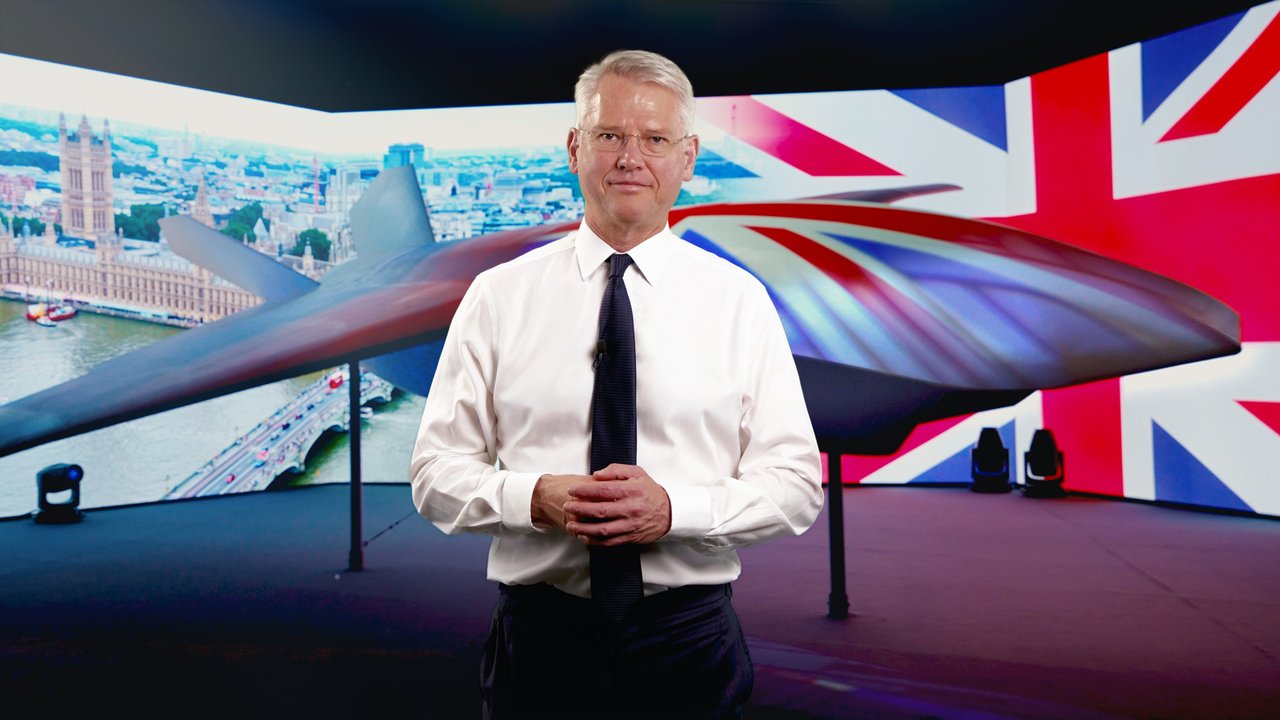
Across the business, our outstanding teams have delivered another strong period of operational and financial performance, which gives us the confidence to upgrade our full year guidance.
Alongside our focus on meeting our customers' needs today, we continue to invest in our business to accelerate innovation, drive efficiencies and boost capacity, so we can get mission-critical capabilities into the hands of those who need them, faster. Examples include our new collaborative combat aircraft, designed to enable our customers to deploy a combined future force of crewed and uncrewed fighter jets, and investment in our facilities in Texas and New Hampshire to support the US Government’s ambition to quadruple production of critical munitions.
The global threat picture remains highly volatile and governments are responding with sustained increases in their defence budgets. The combination of our proven execution, diverse geographic footprint and continued investment in our technology and facilities, alongside our healthy order backlog and growing opportunities across our markets, positions us to keep delivering long-term growth.Charles WoodburnChief Executive

Financial highlights
| Financial performance measures as defined by the Group 1 | Six months ended 30 June 2026 | Six months ended 30 June 2025 | Variance 2 |
|---|---|---|---|
| Sales | £15,772m | £14,621m | +9% |
| Underlying earnings before interest and tax (EBIT) | £1,701m | £1,550m | +11% |
| Underlying earnings per share (EPS) - basic | 38.9p | 34.7p | +13% |
| Free cash flow | £1,791m | £(368)m | £2,159m |
| Order intake | £16.4bn | £13.2bn | £3.2bn |
| As at 30 June 2026 | As at 31 December 2025 | Variance | |
|---|---|---|---|
| Order backlog | £84.0bn | £83.6bn | £0.4bn |
| Financial performance measures as derived from IFRS | Six months ended 30 June 2026 | Six months ended 30 June 2025 | Variance 2 |
|---|---|---|---|
| Revenue | £14,615m | £13,571m | +8% |
| Operating profit | £1,504m | £1,327m | +13% |
| EPS - basic | 34.1p | 32.3p | +6% |
| Net cash flow from operating activities | £2,243m | £74m | £2,169m |
| Dividend per share | 15.0p | 13.5p | +11% |
| As at 30 June 2026 | As at 31 December 2025 | Variance | |
|---|---|---|---|
| Order book | £62.7bn | £63.1bn | £(0.4)bn |
As defined by the Group
- Sales increased 9%2, with all sectors contributing growth in the period.
- Underlying EBIT was up 11%2, increasing the Group’s return on sales for the period to 10.8% (2025 10.6%).
- Underlying EPS increased 13%2 to 38.9p, after accounting for the Group’s underlying net finance costs and tax.
- Free cash inflow of £1,791m reflected a high level of customer advances. No material advances were received in the comparative period.
- Order intake of £16.4bn remained high across all sectors and we closed the period with a record order backlog of £84.0bn.
As derived from IFRS
- The reported growth in revenue of 8%2 reflected the same strong operational performance across the portfolio excluding the impact of our equity accounted investments.
- Operating profit increased 13%2 as the Group incurred lower costs in relation to amortisation of acquired intangibles and adjusting items which are excluded from Underlying EBIT.
- Basic EPS was up 6%2 to 34.1p after accounting for the Group’s net finance costs and tax, with both higher finance costs and effective tax rate contributing to the reduction in growth compared to operating profit.
- Net cash flow from operating activities is also inclusive of movements in customer advances in the period, as well as timing of other working capital requirements.
- We monitor the underlying financial performance of the Group using alternative performance measures (APMs). These measures are not defined in International Financial Reporting Standards (IFRS) and therefore are considered to be non-GAAP (Generally Accepted Accounting Principles) measures. The relevant IFRS measures are presented where appropriate. The purposes and definitions of non-GAAP measures are provided in the Alternative performance measures section on page 38.
- Growth rates for sales, underlying EBIT and underlying EPS are on a constant currency basis (i.e. calculated by translating the results from entities in functional currencies other than pounds sterling for the period ended 30 June 2025 to pounds sterling at the average exchange rate of such currencies for the period ended 30 June 2026). The comparatives have not been restated. All other growth rates and year-on-year movements are on a reported currency basis.
Delivering for our customers
Our focus on operational performance and contracting discipline enables us to consistently deliver critical capabilities and technologies for our customers. Our products and services remain in high demand and, in the first half of the year, we secured £16.4bn of orders while making good progress executing on our major long-term programmes.
Highlights since the beginning of the year included:
- Securing a contract from the UK Government to provide the Republic of Türkiye with training, support equipment and services to its 20 Typhoon aircraft ordered in October 2025. Manufacturing is already underway in the UK and across the Eurofighter partner nations, with first delivery scheduled for 2030.
- Successful APKWS® precision weapon test firing from a Eurofighter Typhoon, demonstrating an effective, affordable counter-drone solution. In rapid collaboration with the UK Royal Air Force (RAF), the system was moved from testing to operational deployment in the Middle East in under two months, significantly enhancing the RAF's ability to counter emerging threats in the region.
- Unveiling Brontanax™ at the Farnborough International Airshow in July, which will be the UK's first uncrewed autonomous Collaborative Combat Aircraft (CCA). The first-of-its class CCA, designed and built by engineers at our Warton site in the UK, is intended to provide electronic warfare and precision strike capabilities against airborne and ground targets.
- Edgewing secured its first international contracts for the Global Combat Air Programme (GCAP) with a combined value in excess of £5bn. This will enable completion of the advanced concept and assessment phase of the programme, together with further joint detailed design and development.
- Signing a landmark seven-year framework agreement with the US Department of War (DoW) to quadruple production and accelerate delivery of the infrared seeker for the Terminal High Altitude Area Defense (THAAD) interceptor missile in support of the DoW’s Acquisition Transformation Strategy.
- Securing an additional award for M109A7 Paladin Self-Propelled Howitzer sets valued at $535m (£398m), building on the multi-year US Army contracts awarded in 2025 and providing advanced firepower and manoeuvrability to enable artillery units to rapidly deploy and engage targets with precision.
- Receiving a contract valued at over $200m (£149m) for ARCHER artillery systems and securing a $180m (£134m) contract for TRIDON Mk2 anti-aircraft and counter-UAS systems, both produced by our Bofors business in Sweden.
- Completing the Preliminary Design Review for the $1.2bn (£0.9bn) Epoch 2 missile warning and tracking satellite programme less than nine months from the US Space Force contract award, whilst also receiving incremental funding of $373m (£277m) in the first half.
- Supporting the A$2.5bn (£1.3bn) export agreement of Australia’s High Frequency Surveillance capability system to establish an Arctic Over the Horizon Radar (A-OTHR) in Canada. The agreement, which is effective from 1 July 2026, will be Australia’s largest ever defence export.
- Securing a new £5.9bn contract to fund critical work to progress the UK's Dreadnought Class nuclear deterrent submarines, which the Secretary of State for Defence will announce at our Barrow-in-Furness site in July.
Investing to support future growth
We continue to invest in our business to drive innovation, enhance efficiency and boost capacity, as we deliver on our programmes and rise to the emerging threats our government customers are facing:
- We continued to develop our drone and counter-drone portfolio to deliver additional frontline capabilities for our customers. The British Army and Royal Navy trialled our one-way effector, Nyan, and we plan to conduct initial trials of our BAE Systems Anti Threat System, using smart software, electronic warfare and kinetic measures to tackle drone threats in August.
- We completed the acquisition of Aston Harald Mekaniska Verkstad AB, a Swedish provider of precision machined, large, complex structures for aerospace, defence and commercial products, helping to enhance security of supply to our Bofors artillery business as it ramps up production capacity and delivery capability.
- We remain committed to ramping up our production capacity at our Hägglunds facility in Sweden and are on track to invest more than $300m (£223m) over a five-year period. Investments include building a new logistics centre and integration and inspection facility, as we continue to accelerate production to meet the rising demand for combat vehicles across Europe.
- We opened a new facility in Utah, US, which will serve as an extension of our presence in the area supporting Intercontinental Ballistic Missile sustainment and modernisation efforts, providing a state-of-the-art workspace for engineering, digital transformation and mission operations teams.
- We completed our 150,000 sq-ft expansion of our state-of-the-art Endicott campus in New York and announced a further $135m (£100m) investment for facility enhancements in Austin, Texas, and Hudson, New Hampshire, to boost our precision-guided munitions production capacity.
- We made good progress towards our target to recruit more than 1,100 apprentices and around 1,200 graduates and undergraduates in the UK by the end of 2026.
- We launched a new technology incubator programme, Launchpad, which aims to move defence technologies beyond prototype development by funding early-stage ventures or spinning them out into independent businesses. During the period, we created a start-up business focused on ultrasound technology enabling wireless transmission of data and power through solid barriers and committed €50m (£43m) to venture capital funds backing European defence-tech start-ups.
Capital distributions
- In the first six months of the year, we returned £933m to shareholders through dividends and our share buyback programme, a 10% increase compared to the £849m returned in the first half of 2025.
- The Board has declared an interim dividend of 15.0p in respect of the first six months of the year, which will be paid on 2 December 2026.
2026 Upgraded Group guidance 1
Given the strong operational performance in the first half, we are upgrading guidance across all key financial performance measures for the full year, as shown in the table below. Our cumulative three-year free cash flow guidance for 2024 to 2026 has also been upgraded while the cumulative three-year free cash flow guidance for 2025 to 2027 and 2026 to 2028 remains unchanged.
Guidance is provided on a constant currency basis using an exchange rate of $1.32:£1, which is in line with the actual 2025 exchange rate.
| Year ended 31 December 2026 | Updated guidance | Previous guidance | Year ended 31 December 2025 Results |
|---|---|---|---|
| Sales | Increase in the range of 8% to 10% | Increase in the range of 7% to 9% | £30,662m |
| Underlying EBIT | Increase in the range of 10% to 12% | Increase in the range of 9% to 11% | £3,322m |
| Underlying EPS | Increase in the range of 11% to 13% | Increase in the range of 9% to 11% | 75.2p |
| Free cash flow target | >£2.0bn | >£1.3bn | £2,158m |
| 2024 to 2026 cumulative free cash flow | >£6.7bn | >£6.0bn |
- Underlying net finance costs c.£340m (previously c.£370m)
- Effective tax rate c.22%
- Non-controlling interests c.£80m
Sensitivity to foreign exchange rates: the Group operates in a number of currencies, the most significant of which is the US dollar. As a guide, a 5 cent movement in the £/$ exchange rate will impact sales by c.£500m, underlying EBIT by c.£70m and underlying EPS by c.1.4p.
- Whilst the Group is subject to geopolitical and other uncertainties, the Group guidance is provided on current expected operational performance. The guidance is based on the measures used to monitor the underlying financial performance of the Group. Reconciliations from these measures to the financial performance measures defined in IFRS are provided in the Alternative performance measures section on page 38.
Ref: 090/2026