

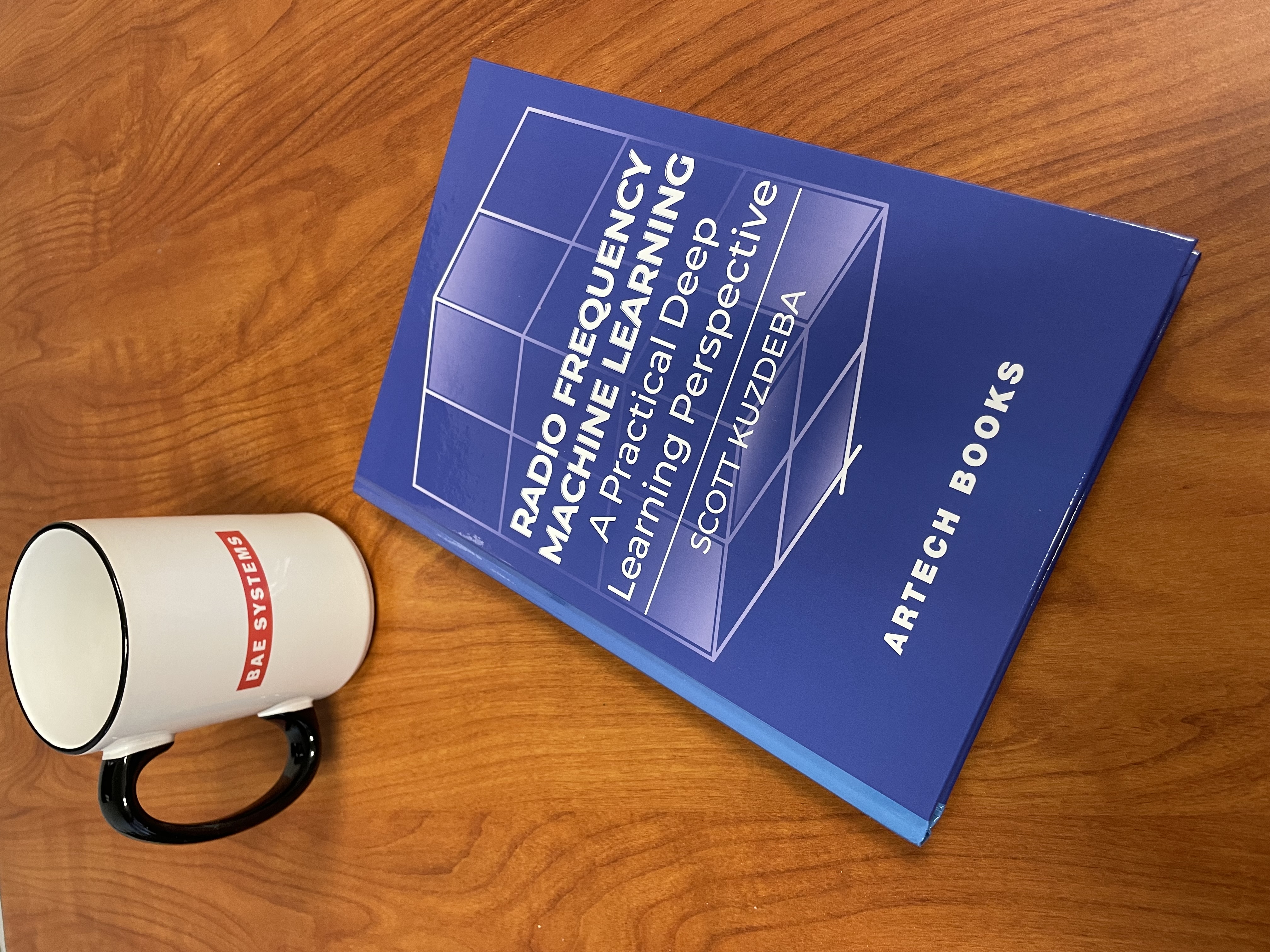
The radio frequency (RF) spectrum and machine learning algorithms are essential technologies for the warfighter, and FAST Labs' Dr. Scott Kuzdeba literally wrote the book on the subject: “Radio Frequency Machine Learning: A Practical Deep Learning Perspective.”

We sat down with Dr. Kuzdeba to discuss autonomy, the RF spectrum, and their impact on future applications.
Can you tell us a little bit about your role?
Scott: As the director of the Edge and Spectral Artificial Intelligence group within BAE Systems' FAST Labs™ research, development, and production organization, I work closely with governmental organizations, including DARPA, IARPA, and AFRL, as well as multiple university partners. My goal is to develop new radio frequency machine learning (RF ML) solutions to address the defense industry's most challenging problems.
But deeper than my title, I’m someone who enjoys working in the whitespace and pushing the bounds of our current knowledge. In particular, I focus on where we currently have challenges and where there is potential for big impacts. This passion brought me to the world of research and development, where I try to move state-of-the-art tech forward and build prototype systems. Right now, I am working on sensors and modalities that are critical for defense applications. My background training in neuroscience, engineering, and economics has proven useful in an environment where the challenges we face are extremely complex and rely on multidisciplinary approaches.
I see you recently had your book published; can you explain the topic to a non-technical audience?
Scott: I work mostly in the electromagnetic spectrum. Wireless technologies have become heavily embedded within today’s world, in everything from how we connect to the internet and our mobile networks, to how we perform navigation and tracking of objects — like the GPS systems we use when we drive a car. However, our growth in wireless tech use brings with it an ever-growing number of devices emitting their own unique types of signals. Couple this high level of electromagnetic “traffic” with the shift toward digitization and software reconfigurability and you have a situation that is ripe for new innovations. This space is quickly getting far too complex for humans to engineer solutions alone. My book looks at addressing these challenges with artificial intelligence (AI).
Discussion about AI is everywhere now; can you tell us a little bit more about how your book relates to the AI we hear about all the time?
Scott: Everyone is familiar with large language models (LLMs) and computer vision (CV) models that have taken over and completely changed many fields. Think ChatGPT and self-driving cars (e.g., Waymo). These models learn from large amounts of data and then perform new tasks when presented with new inputs, often surpassing human capability. These models are specialized in language and vision, two important human modalities. Wireless signals, however, are not perceived by humans, nor are they grounded in the same underlying physics as language or speech.
Therefore, we need different AI models that are created specifically for the physical properties of electromagnetic waves to tackle wireless problems. My book explores this by looking at how modern deep learning methods can be applied and updated for the wireless domain to address a wide variety of applications, such as spectrum understanding and generative waveform development.
Why is this topic important to the defense community?
Scott: The defense field is heavily reliant on the electromagnetic spectrum to understand what is occurring (wireless signals can travel farther than line-of-sight vision), perform communication and control, and mitigate and defend against adversary weapon systems. In the commercial world, wireless signals are often heavily regulated and bounded in how they operate.
However, this is not the case in defense applications, where environments are harsh, rapidly evolving, and generally challenging. For example, early in the Russia-Ukraine war, Starlink was introduced to enable resilient command and control. More recently, drone communication systems have been updated to operate over fiber optics. In both cases, the tech was adapted to avoid signal jamming (something regulated and fined in the commercial world). These situations demonstrate the pace at which military signals are changing, with human capability being the “bottleneck” in the rapid iteration. AI has the potential to alleviate the human choke point by automating much of the engineering process.
If people are interested in this topic, where can they learn more?
Scott: Many professional societies are putting spotlights and a focus on how AI can be brought into their respective fields. Within the electromagnetic spectrum, there are several professional societies that put specific emphasis on it. One of those is the Association of Old Crows (AOC), which puts a focus on electromagnetic warfare (EW) and has several great conferences for connecting and learning more. Another is the Institute of Electrical and Electronics Engineers (IEEE), which hosts many conferences, seminars, and learning opportunities.
An example is the recent military communications conference (MILCOM) in Los Angeles. At that conference, I gave a tutorial on generative AI for waveform development and hosted a panel to discuss trustworthy and adversarial AI.
About Dr. Kuzdeba:
Dr. Kuzdeba frequently publishes peer-reviewed papers, holds several patents within the RF ML field, and is an active member of the AOC, AAAI, and IEEE. He received his PhD in computational neuroscience from Boston University, where the inspiration for his artificial intelligence work stemmed from studying biological neural networks related to speech perception and articulation.
More information on his book and work can be found in this interview: Exclusive Interview from our Author Scott Kuzdeba – Artech House Insider.