
Operators can task and adjust behaviour of swarms without navigating layers of interfaces or issuing step-by-step commands.Bashar AhmadExecutive scientist
These are fundamental questions. They’re the reason swarming has stayed out of reach for real operational use. We’re focusing on solving exactly that – turning swarms from something you hear about into something you can actually command.
The problem isn’t the drones. It’s the control.
For years, uncrewed systems have scaled in number, but still present a high workload for human operators. More platforms mean more screens, more inputs and more decisions. That model doesn’t scale.
Rather than think about every drone individually, operators need the ability to direct outcomes across many assets at once.
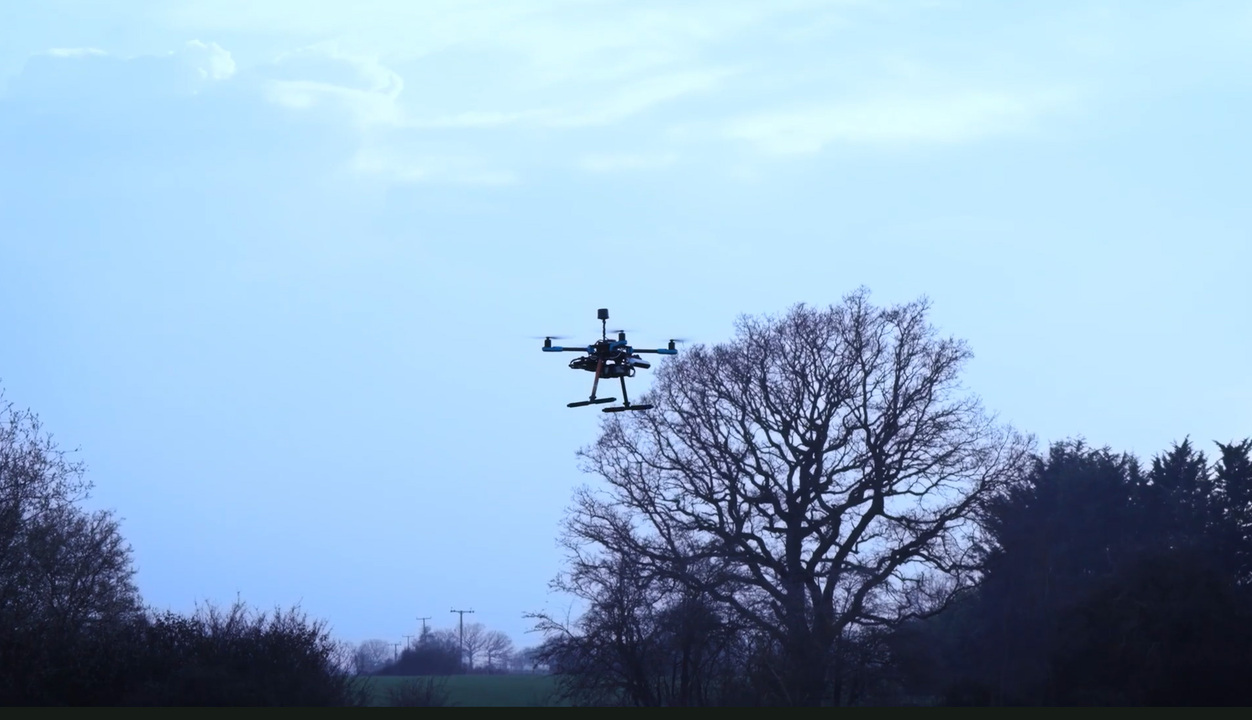
Instead of manually controlling each platform, we’re enabling a single operator to oversee a self-organising group – a swarm. Each asset carries its own onboard intelligence and can have different capabilities. It can understand its environment, coordinate with others, and adapt in real time.
The operator defines the objective – the intent – and the swarm determines how to achieve it. Our AI drone controller translates that intent into coordinated action across multiple systems.
Usually, more platforms mean more decision and workload.
Our AI Drone Controller enables a single operator to direct a self-organising swarm.
Each platform can coordinate, adapt and respond in real time.
Simple to use. Designed for trust.
Autonomy only works if operators trust it.
We’ve built interaction with our drone controller around natural language, spoken or written. Operators can task and adjust behaviour of swarms without navigating layers of interfaces or issuing step-by-step commands. It’s not about constant dialogue. It’s about reducing effort while maintaining visibility, authority and confidence in what the system will do.
Built for the real world
Swarms need to work under pressure. In contested environments, assets will be lost, communications degraded and conditions constantly changing. The system has to adapt without stopping the mission.
Our system uses a decentralised, multi-agent approach where each platform can make decisions locally while coordinating with the wider group. If one asset drops out, the others reorganise and continue, so it is a true self-healing swarm. The result is resilience – not just scale.
From concept to capability
This isn’t theoretical. We’re already demonstrating coordinated behaviour across multiple air and ground systems, and scaling towards multi-domain swarms controlled by a single operator using natural language.
The drive is simple: moving swarming from discussion and into the hands of the people who need it.
What this unlocks
When operators no longer have to manage every platform, everything changes. They focus on the mission, not the mechanics. Capability scales without scaling workload and decisions happen at the speed modern operations demand.
That’s the shift: from operating drones to commanding outcomes.