
The success of the Gloster Meteor led to de Havilland Aircraft Company being approached to design an airframe for the Halford H1 turbojet engine, which would later become the DH Goblin. Initially designated DH.99 and nicknamed the ‘Spider Crab,’ the aircraft featured an unorthodox twin rear-boom design with a moulded, egg-shaped wood and aluminium fuselage and a single engine. The relatively low power of early jet engines typically required twin engines, but Major Frank Halford's new engine was highly efficient, allowing the possibility of a single-engine fighter.
To improve efficiency and meet Ministry recommendations, the design was modified into a mixed wood and metal construction and re-designated the DH.100 Vampire. The prototype Vampire (LZ548/G) was first flown on 20th September 1943 at Hatfield by Geoffrey R de Havilland (son of the company founder).
The first production DH Vampire (F.1) was produced by English Electric Company at Warton due to production pressures at Hatfield. Although it arrived after the end of the Second World War, the DH Vampire became the second British jet fighter to serve with the RAF (after the Gloster Meteor) and had the honour of leading the VE-Day flypast over London. The Vampire was the first RAF aircraft to exceed 500 mph and became instantly recognisable with its distinctive twin tail-boom and pod-like fuselage.
The main production version was the DH Vampire FB.5 fighter-bomber, based on the DH Vampire F.3, and was the foundation for many export versions. Separate night fighter (DH.113 Vampire NF) and trainer (DH.115 Vampire Trainer) models were also produced. A number of DH.100 Vampires were also modified for shipboard use and on 3rd December 1945, Captain Eric 'Winkle' Brown completed the first successful landing and take-off of a jet fighter from an aircraft carrier while piloting a DH Vampire from the carrier HMS Ocean. It was also significant at the first jet fighter operated by the Royal Navy.
The DH Vampire was widely successful in the export market, with around 30 air forces operating the type. In 1946, the Royal Australian Air Force purchased fifty DH.100 Vampire F1, F2, and FB variants.
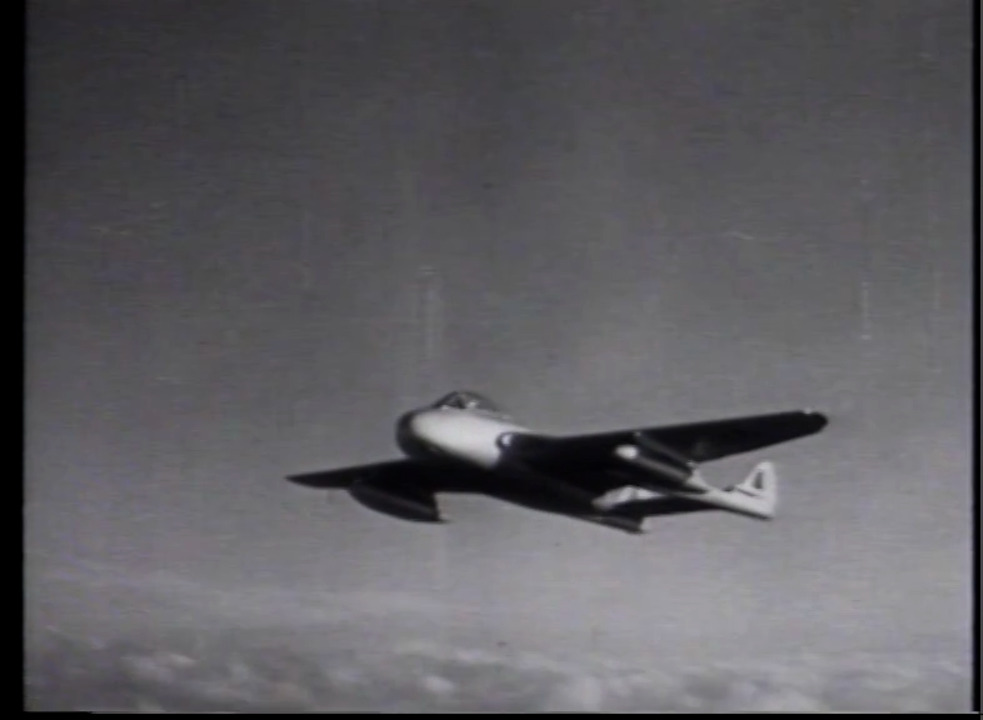
Extract from the company film "de Havilland Diary, 1949", featuring the DH.100 Vampire, and interviews with the de Havilland Aircraft Company test pilots John Cunningham and John Derry.
BAE Systems Heritage
An experimental DH Vampire with an extended wingspan and DH Ghost engine set a World Altitude record of 59,446 ft in March 1948. Later that year, six DH Vampire F3s became the first jet fighters to fly across the Atlantic during the ‘RAF Goodwill Tour of Canada’. By the end of production, 3,269 Vampires had been built in the UK, with an additional 1,067 built abroad under licence.
The DH Vampire remained in RAF front-line service until 1953, after which it was relegated to pilot training and refresher roles, and was finally retired from RAF service in 1966, replaced by the Hawker Hunter and Gloster Javelin. However, the aircraft enjoyed surprising longevity in other air forces, remaining in service into the 1980s. The Swiss Air Force was the last to operate the Vampire, retiring their DH Vampire FB.6s and T.55s in 1990.
Despite its retirement, many Vampires are still airworthy today due to their simple design and ease of maintenance, and over a hundred aircraft are on display in museums worldwide.