
In this video, we explore how helmet has evolved across the decades through new technologies, new materials and new capability. Much of that journey has been shaped by our engineers in the UK, and it continues today as we proudly maintain our position as world leaders in helmet capability.
Protection from the elements
In the 1940s, leather helmets were introduced to shield pilots from the cold, the wind and the noise of the engine. They were simple by today's standards, but they marked the beginning of the helmet as essential kit.
Around this time, the first Head-Up Displays (HUDs) also began to appear. During the Second World War, the Spitfire carried a fixed HUD in the form of a cross reflected onto a piece of glass, giving the pilot basic targeting. It was a modest innovation, but it helped pilots improve their firing accuracy during the conflict.
The first HUD and the hard helmet
By the 1960s, aircraft were becoming far more capable and significantly faster. With greater speed came the ejection seat, and with it a new set of challenges. A pilot could now be launched into an incredibly fast airstream, so the risk of injury rose sharply. This led to the development of the harder helmets we recognise today.
The HUD evolved in parallel. A BAE Systems predecessor company, Elliott Automation, based in Kent, pioneered the world's first HUD for the Blackburn Buccaneer in 1961. These displays unlocked a new capability. Pilots could manoeuvre without looking down, with flight information such as altitude presented directly in front of their eyes, allowing them to line up targets while keeping their heads up.
Judging distance in three dimensions
The next step was to make the helmet an active aid to the mission. Basic cueing systems began to emerge through the introduction of binocular optics. These gave pilots the depth perception and accurate distance judgement they needed to navigate, manoeuvre and target in three dimensions. Compared with today, the technology was relatively heavy, but it marked the start of much greater capability to come.
It was also the era when night vision first entered the cockpit in earnest, and the limitations of that early kit shaped much of the engineering that followed.
The dark of the night
One of the biggest challenges for a fighter pilot is flying at night. Night vision goggles that attach to the helmet create strain on the head and neck, and that strain grows the faster you fly. In a 9G-capable aircraft such as Typhoon, those extreme conditions are pushed to the limit. For the Striker I system, night vision goggles are limited to 4.5G.
LED precision
By the 1990s, the technology had advanced enough to replace the heavy binocular system with something far lighter. The new approach used LED technology to reflect a pattern of fine lines, such as a crosshair onto a semi-reflective patch on the visor, working across one eye. The helmet and the aircraft worked together so each knew where the pilot was looking. It wasn't the most accurate solution, but it was simple, and it could cue weapons.
This system went into production on the Jaguar, unlocking a capability that hadn't been there before.
Striker® Helmet-Mounted Display
The Striker helmet became the first 600-knot capable helmet on the market. It was significantly lighter than anything before it, thanks to the arrival of lighter materials such as carbon fibre composite and Kevlar.
A new, more lightweight binocular system gave pilots a more comfortable fit and a larger display, improving situational awareness. Pilots could change modes on the screen to select exactly the information they needed, making the role easier and safer.
The pursuit of that balance is harder than it looks, as our engineers in Rochester know well.
The Striker system remains in service today. It has continued to evolve, drawing on the latest tracking technologies, growing processing capability and the emergence of new lightweight materials.
The helmet is a complex trade space. For every change you make, that changes something else, so you are forever looking for that optimal balance between weight and capability. With Striker, we went as far as drilling out the centre of each screw to take weight out of the helmet.Nigel, Rochester
Striker® II
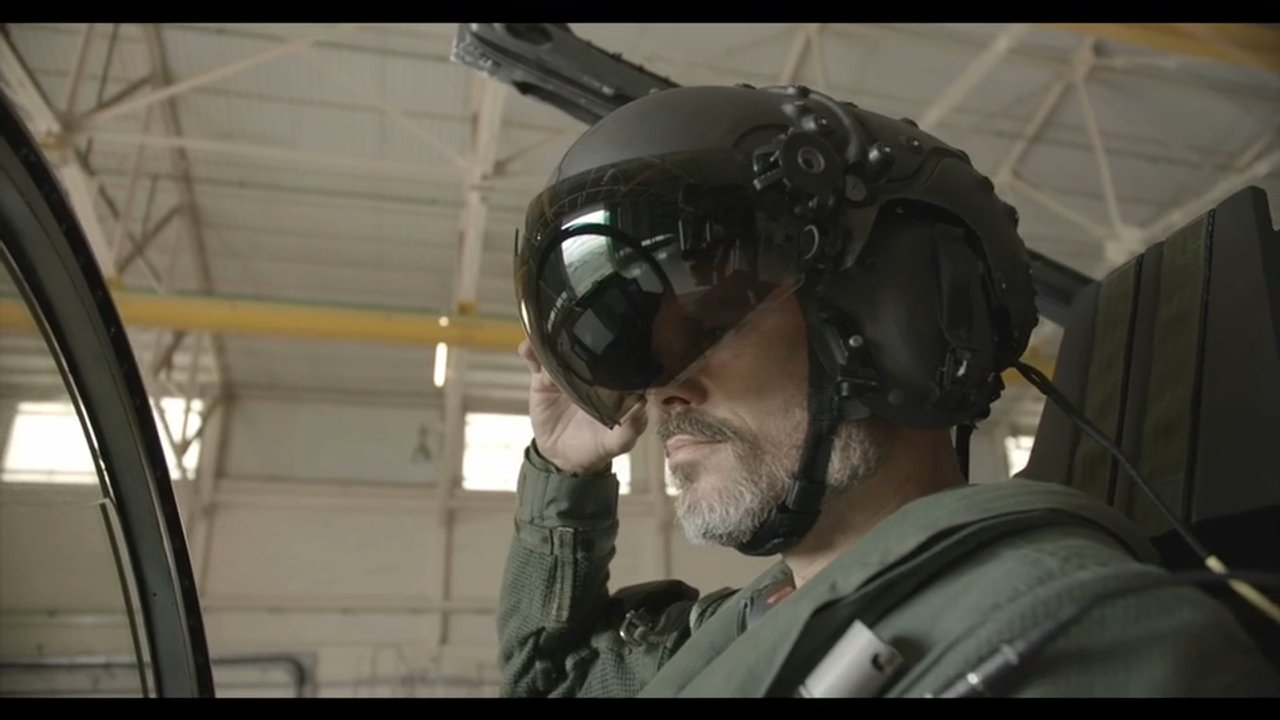
Striker II is the latest generation in helmet technology. From the outside, it looks much like Striker. Under the skin, it is very different.
Digital technology has advanced significantly over the past decade, and this latest generation helmet now carries a built-in night vision camera. It is the only helmet in the world with a full colour HD display, bringing day and night situational awareness together in a single, integrated system.
Striker II is set to enter service with the Royal Air Force’s Eurofighter Typhoon fleet before the end of the decade.
One step ahead
Striker II benefits from zero latency. When display technology was first introduced, the image would appear a fraction of a second after the pilot moved their head, which could create a dizzying or swimming effect. The hybrid tracking technology in Striker II predicts the pilot's head movement in milliseconds, so the image is ready to display at the right point the moment the pilot stops. That combination of a full colour HD display, fully integrated night vision and zero latency hybrid tracking is unique to Striker II.
Striker II has been designed and developed with the future in mind. Across our business, our engineers are already exploring the next generation of helmet-mounted capability. At our Aerospace & Mission Systems business in Rochester, Kent, where Striker and Striker II were designed and developed, engineers are maturing Project Intuity™, our next-generation helmet-mounted demonstrator, announced at the 2026 Farnborough International Airshow.
This is a massive leap in capability that makes the helmet a much more seamless, comfortable and integral part of the aircraft and the mission.Andrew Mallery Blythe, Typhoon Operational Requirements Manager and Evaluator Pilot
What comes next?
Over the next century, the pilot's role will change even more than it has over the past 100 years. For decades, the helmet has protected pilots and widened what they can see. Now it's becoming a tool that helps them decide. Today's mission commander will become the operator of a fully integrated, AI-assisted battlespace that they wear rather than sit in.
At BAE Systems, we've built a mixed reality cockpit concept on the full-colour display of the Striker II Helmet-Mounted Display. Instead of relying on fixed physical instruments, the helmet projects augmented and virtual reality displays and controls directly in front of the pilot's eyes. Our engineers are exploring how pilots can shape that interface using voice, gesture and touch. They can add terrain overlays, restricted airspace or 3D situational displays as the mission demands. Because the cockpit lives in software, pilots can reconfigure it in flight. We can also upgrade it affordably as new sensors, weapons and threats emerge.
This is technology designed and developed in the UK, drawing on sovereign skills and capability built up over a century and delivering for what comes next.